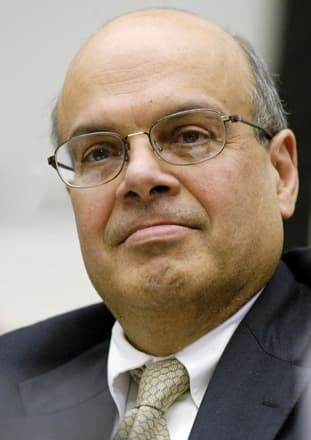
Ajit Jain
Vice Chairman of Insurance Operations, Berkshire Hathaway
Head of Berkshire's vast insurance operations since 1986; one of Buffett's most trusted executives.
Biography
Ajit Jain was born and raised in India and joined Berkshire Hathaway in 1986, building from nothing one of the world's most extraordinary reinsurance empires. He became Vice Chairman of Insurance Operations in 2018, overseeing all of Berkshire's insurance businesses.
The story of Ajit's hiring is itself legendary. On a Saturday morning, he walked into Berkshire's Omaha office. Buffett recalls asking Ajit what insurance experience he had. Ajit said: "None." Buffett said: "Nobody's perfect," and hired him on the spot. "That was my lucky day," Buffett wrote in 2021. Ajit actually was the perfect man for the job. And, better yet, 35 years later he still is.
The man who found Ajit was Mike Goldberg, whom Buffett thereafter reverently called "St. Mike." Starting with a small, struggling reinsurance operation at National Indemnity, Ajit built it into an industry unto itself. His team has always been tiny — never more than a few dozen people — yet operates one of the world's largest reinsurance businesses by assets and the world's largest by individual risk size.
Key Stories
No Experience Required — When Ajit joined in 1986 with zero insurance experience, it seemed absurd. But Buffett saw qualities that transcended a résumé — intelligence, integrity, energy, and independent judgment. This hiring decision became a model for Berkshire's people philosophy: bet on character and capability, not credentials.
31 People, World's Largest Risks — In 2008, Buffett described Ajit's Stamford office: only 31 employees. This may be one of the most extraordinary businesses in the world — difficult to describe but easy to admire. With this tiny team, Ajit underwrites single risks that no other insurer will touch — individual policies of $1 billion or more.
The Lloyd's Rescue — In the 2009 letter, Buffett detailed how Ajit helped clean up massive liabilities from Lloyd's of London, untangling relationships with 27,972 Names (individuals who'd put their fortunes at risk). A single contract: $7.1 billion in premium. Another deal that year could bring $50 billion in premiums over 50 years.
"Don't Worry About My Health" — In 2000, Buffett wrote: Ajit's value to Berkshire is impossible to exaggerate. Don't worry about my health. Worry about his. This half-joking remark was a sincere business judgment: Buffett genuinely believed Ajit's continued presence was more critical to Berkshire than his own.
Impact on Berkshire
Ajit Jain's contribution to Berkshire is among the most extraordinary in corporate history — building a multi-billion-dollar business from zero with a team that never numbered more than a few dozen people.
Float Machine: Ajit's reinsurance operation generates tens of billions in underwriting float — the central engine of Berkshire's investment leverage. Crucially, this float has been cost-free or better: Berkshire not only uses the money for free, it actually profits from underwriting.
Risk Discipline: Ajit has rejected 98%+ of business brought to him. This "no" reflex — declining risks that others might accept — is as valuable as his ability to say "yes" to the right mega-risks at the right price.
Organizational Marvel: A business of this scale run by dozens of people is without precedent in financial history, perfectly expressing Berkshire's minimal-bureaucracy philosophy.
In 2024, Buffett placed Ajit among Berkshire's three most consequential decisions: Think about GEICO as a business decision, Ajit Jain as a personnel decision, and how lucky I was to find Charlie Munger. Mistakes fade away; wins can forever blossom.
Key Passages from Buffett's Letters
Mike Goldberg, with special help from Ajit Jain, Dinos Iordanou, and the National Indemnity managerial team, has positioned us well in that respect. At some point - we don’t know when - we will be deluged with insurance business. The cause will probably be some major physical or financial catastrophe. But we could also experience an explosion in business, as we did in 1985, because large and increasing underwriting losses at other companies coincide with their recognit
*Mike Goldberg and his management team of Rod Eldred, Dinos Iordanou, Ajit Jain, Phil Urban, and Don Wurster continue to position us well for this eventuality. Mar ket abl e Secur i t i es In selecting marketable securities for our insurance companies, we generally choose among five major categories: (1) long-term common stock investments, (2) medium-term fixed income securities, (3) long-term fixed income securities, (4) short-term cash equivalents, and (5) short-term *
Mike Goldberg, and his cadre of stars, Rod Eldred, Dinos Iordanou, Ajit Jain, and Don Wurster. In assessing our insurance results over the next few years, you should be aware of one type of business we are pursuing that could cause them to be unusually volatile. If this line of business expands, as it may, our underwriting experience will deviate from the trendline you might expect: In most years we will somewhat exceed expectations and in an occasional year we will fal
Ajit Jain, who runs our reinsurance operation, is simply the best in this business. In combination, these strengths guarantee that we will stay a major factor in the super-cat business so long as prices are appropriate. What constitutes an appropriate price, of course, is difficult to determine. Catastrophe insurers can't simply extrapolate past experience. If there is truly "global warming," for example, the odds would shift, since tiny changes in atmospheric conditi
Ajit Jain, whose value to Berkshire is simply enormous. In the reinsurance field, disastrous propositions abound. I know that because I personally embraced all too many of these in the 1970s and also because GEICO has a large runoff portfolio made up of foolish contracts written in the early-1980s, able though its then-management was. Ajit, I can assure you, won't make mistakes of this type. I have mentioned that a mega-catastrophe might cause a catastrop