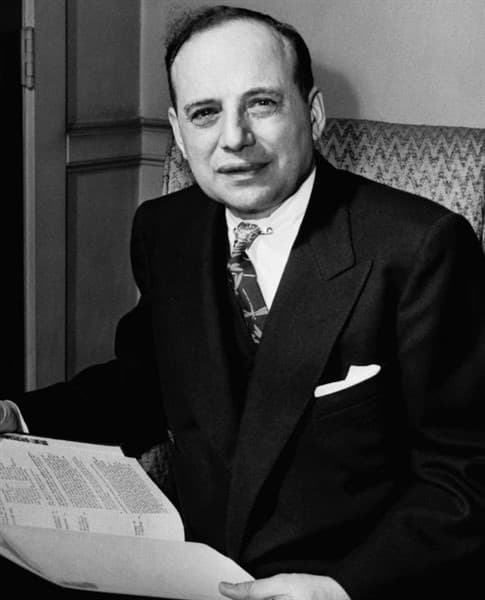
Benjamin Graham
Mentor & Intellectual Father
Professor at Columbia Business School; Buffett's most influential teacher and early employer at Graham-Newman Corp.
Biography
Benjamin Graham (1894–1976) was the father of value investing and Warren Buffett's most influential intellectual mentor. Buffett studied under Graham at Columbia Business School, where he is the only student Graham ever awarded an A+. He later worked at Graham-Newman Corporation before launching his own partnership in 1956.
Graham's two seminal works — Security Analysis (1934, with David Dodd) and The Intelligent Investor (1949) — established the intellectual scaffolding Buffett built his career upon. In the 1984 letter Buffett called The Intelligent Investor "by far the best book on investing ever written," and in the 2013 letter he wrote that the key points that guide his investing decisions today were laid out in what later editions of the book labeled Chapters 8 and 20 — the chapters on Mr. Market and the margin of safety.
Graham's core insight: stocks are ownership stakes in real businesses, not ticker symbols. Mr. Market is your servant, not your guide — use his mood swings to your advantage, never let them drive your decisions. Buffett bought the book in 1949 and has said his financial life changed with that purchase.
Key Stories
The Only A+ Student — Buffett has said that Graham gave him more than anyone except his father. In the classroom at Columbia, Graham created an environment of Socratic inquiry into business value that permanently shaped how Buffett thinks.
"The Margin of Safety" — Graham's most durable concept. Buy securities at a significant discount to intrinsic value, and you have a cushion for errors in analysis and bad luck. Buffett has carried this principle throughout his career, even as he evolved beyond pure Graham-style investing.
The Book That Bought GEICO — The 2013 letter records a remarkable sidelight: later editions of The Intelligent Investor included a postscript describing an unnamed investment that was a bonanza for Graham. He made the purchase in 1948, while writing the first edition — and the mystery company was GEICO. Buffett draws the line directly: had Graham not recognized GEICO's special qualities in its infancy, Buffett's future and Berkshire's would have been far different.
Evolving Beyond Graham — Buffett eventually moved past Graham's strict "cigar butt" approach — buying cheap regardless of business quality — partly under Munger's influence. But he never abandoned Graham's fundamental principles: value orientation, margin of safety, and the Mr. Market mental model. Before reading Graham, Buffett wrote in 2013, he had wandered the investing landscape devouring everything — charting, watching the tape, listening to commentators — fascinated but getting nowhere. Graham's ideas, explained in elegant prose without Greek letters or complicated formulas, ended the wandering.
Impact on Berkshire
Graham's impact on Buffett — and through Buffett on Berkshire — is immeasurable. Every element of Berkshire's investment philosophy traces back to Graham:
Intrinsic Value: The concept that a business has an underlying economic value independent of its stock price is pure Graham. The entire analytical framework Berkshire uses to evaluate acquisitions flows from this.
Mr. Market: Buffett uses this allegory in nearly every decade of his letters, most fully in the 1987 letter's extended retelling. It remains the best mental model for maintaining emotional discipline during market extremes.
Temperament over IQ: Graham taught that successful investing is more about character than intelligence — avoiding panic and greed is more important than finding the perfect formula. Berkshire's long-term holding philosophy is an expression of this Grahamian lesson.
Skepticism of Reported Numbers: Graham's 1936 satire on accounting practices — which Buffett attached as an appendix to the 1990 letter — stands behind Berkshire's insistence that accounting numbers are a beginning, not an end, in calculating true economic earnings.
Key Passages from Buffett's Letters
(In what I think is by far the best book on investing ever written - “The Intelligent Investor”, by Ben Graham - the last section of the last chapter begins with, “Investment is most intelligent when it is most businesslike.” This section is called “A Final Word”, and it is appropriately titled.)
Ben Graham told a story 40 years ago that illustrates why investment professionals behave as they do: An oil prospector, moving to his heavenly reward, was met by St. Peter with bad news. “You’re qualified for residence”, said St. Peter, “but, as you can see, the compound reserved for oil men is packed. There’s no way to squeeze you in.” After thinking a moment, the prospector asked if he might say just four words to the present occupants. That seemed harmless to St. Peter, so the prospector cupped his hands and yelled, “Oil discovered in hell.” Immediately the gate to the compound opened and all of the oil men marched out to head for the nether regions. Impressed, St. Peter invited the prospector to move in and make himself comfortable. The prospector paused. “No,” he said, “I think I’ll go along with the rest of the boys. There might be some truth to that rumor after all.”
Ben Graham, my friend and teacher, long ago described the mental attitude toward market fluctuations that I believe to be most conducive to investment success. He said that you should imagine market quotations as coming from a remarkably accommodating fellow named Mr. Market who is your partner in a private business. Without fail, Mr. Market appears daily and names a price at which he will either buy your interest or sell you his.
Funny business in accounting is not new. For connoisseurs of chicanery, I have attached as Appendix A on page 22 a previously unpublished satire on accounting practices written by Ben Graham in 1936. Alas, excesses similar to those he then lampooned have many times since found their way into the financial statements of major American corporations and been duly certified by big-name auditors. Clearly, investors must always keep their guard up and use accounting numbers as a beginning, not an end, in their attempts to calculate true "economic earnings" accruing to them.
And now back to Ben Graham. I learned most of the thoughts in this investment discussion from Ben’s book The Intelligent Investor, which I bought in 1949. My financial life changed with that purchase.
If Ben had not recognized the special qualities of GEICO when it was still in its infancy, my future and Berkshire’s would have been far different.