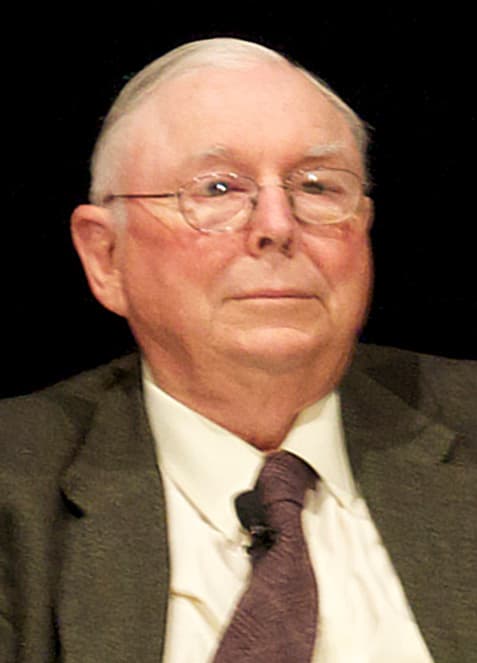
Charlie Munger
Vice Chairman, Berkshire Hathaway
Buffett's longtime business partner and closest intellectual collaborator since the early 1960s.
Biography
Charlie Munger (1924–2023) served as Vice Chairman of Berkshire Hathaway and was Warren Buffett's partner and closest friend for over sixty years. He passed away on November 28, 2023, just 33 days short of his 100th birthday.
Munger was born and grew up in Omaha, just one block from the house Buffett would later buy. As a young man he worked at Buffett's grandfather's grocery store. The two men did not meet until 1959 — Buffett was 28, Munger was 35. An Omaha doctor predicted they would hit it off immediately. They did.
Munger started his career as a lawyer billing $15 an hour, made his first real money building apartment projects in Los Angeles, and in 1962 turned to investment management. His most profound contribution to Berkshire: changing Buffett's philosophy from "buy fair businesses at wonderful prices" to "buy wonderful businesses at fair prices." This shift, crystallized through the 1972 acquisition of See's Candies, was worth hundreds of billions of dollars.
Key Stories
The Architect — Buffett called Munger the "architect" of Berkshire, crediting himself only as the general contractor who goes to work implementing it day after day. This building metaphor — introduced in the 2023 letter after Munger's death — captures how completely Munger shaped the company's long-term design without seeking personal credit.
See's Candies Education — In 1972, Munger urged Buffett to pay $25 million for See's Candies — three times net tangible assets, which made Buffett "flinch." The sellers accepted a lower offer. That investment ultimately generated $1.35 billion in pre-tax earnings and taught Buffett the true value of a powerful brand.
"I've never had a quarrel with him" — Buffett wrote in 2014: For 56 years, Charlie and I have never had an argument. When we differ, Charlie usually ends the conversation by saying: 'Warren, think it over and you'll agree with me because you're smart and I'm right.'
Thumb-Sucking — Munger's phrase for the cardinal sin of delaying correction of known mistakes. He told Buffett: The problem won't go away just because you want it to — you have to act, however uncomfortable. This principle became central to Berkshire's culture of decisiveness.
Impact on Berkshire
Munger's influence on Berkshire was foundational and total. If Graham gave Buffett the foundation of value investing, Munger designed the skyscraper that Berkshire became.
Investment Philosophy: Munger liberated Buffett from Graham's "cigar butt" framework — buying things cheap regardless of quality — and reoriented him toward buying excellent businesses at fair prices. Coca-Cola, Apple, American Express — the investments that generated Berkshire's most spectacular returns — are the fruit of Munger's blueprint.
Corporate Culture: Together they shaped Berkshire's distinctive decentralized management: trust managers completely, no corporate meetings, no annual budgets. Munger's maxim tell me where I'm going to die, so I'll never go there became the foundation of Berkshire's risk culture.
Character: Munger was selfless in a way that is rare in business. He provided the most critical strategic ideas, never took credit, never said "I told you so." After his death in 2023, Buffett left Munger's chair empty at the annual meeting — a permanent tribute.
Key Passages from Buffett's Letters
Louie Vincenti and Charlie Munger in repositioning Mutual Savings and Loan. A copy of the full annual report of either company will be mailed to any Berkshire shareholder upon request to Mr. Robert H. Bird for Blue Chip Stamps, 5801 South Eastern Avenue, Los Angeles, California 90040, or to Mrs. Bette Deckard for Wesco Financial Corporation, 315 East Colorado Boulevard, Pasadena, California 91109. As indicated earlier, undistributed earnings in companies we do not contr
Although our form is corporate, our attitude is partnership. Charlie Munger and I think of our shareholders as owner-partners, and of ourselves as managing partners. (Because of the size of our shareholdings we also are, for better or worse, controlling partners.) We do not view the company itself as the ultimate owner of our business assets but, instead, view the company as a conduit through which our shareholders own the assets.
*An amplified discussion of Wesco’s businesses appears in Charlie Munger’s report on pages 50-59. You will find particularly interesting his comments about conditions in the thrift industry. Our other major controlled businesses are Nebraska Furniture Mart, See’s, Buffalo Evening News, and the Insurance Group, to which we will give some special attention here. Nebraska Furniture Mart Last year I introduced you to Mrs. B (Rose Blumkin) and her family. I told you they *
Despite these important negatives, Charlie and I judged the risks at the time we purchased the bonds and at the prices Berkshire paid (much lower than present prices) to be considerably more than compensated for by prospects of profit.
— 1984 Shareholder Letter (on the WPPSS bond purchase, guaranteed by Bonneville Power Administration)
Charlie Munger, my partner in managing Berkshire, and I are reasonably optimistic about Berkshire’s ability to earn returns superior to those earned by corporate America generally, and you will benefit from the company’s retention of all earnings as long as those returns are forthcoming. We have several things going for us: (1) we don’t have to worry about quarterly or annual figures but, instead, can focus on whatever actions will maximize long-term value; (2) we can expand