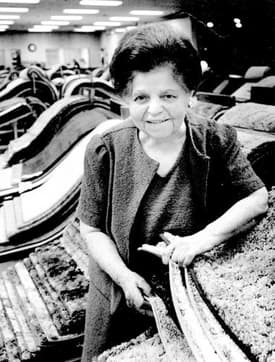
Mrs. B (Rose Blumkin)
Founder, Nebraska Furniture Mart
One of Buffett's most admired entrepreneurs; sold Nebraska Furniture Mart to Berkshire in 1983.
Biography
Rose Blumkin (1893–1998), known to everyone in Omaha as "Mrs. B," founded Nebraska Furniture Mart in 1937 and built it into the largest home furnishings store in the United States. She arrived in Seattle in 1915 as a Russian emigrant unable to read or speak English — at 23 she had talked her way past a border guard to leave Russia. She had no formal education, not even at the grammar school level; she learned English from her older daughter, who taught her each evening the words she had learned in school that day.
After years of selling used clothing, she saved $500 and opened a furniture store, naming it after the American Furniture Mart in Chicago, then the center of the nation's wholesale furniture trade. When her tiny resources ran out early on, she sold the furniture and appliances from her own home to pay creditors precisely as promised. Omaha retailers pressured furniture and carpet manufacturers not to sell to her; she obtained merchandise anyway and cut prices sharply. She was hauled into court for violation of Fair Trade laws, won every case, and at the end of one — after demonstrating to the court that she could profitably sell carpet at a huge discount from the prevailing price — sold the judge $1,400 worth of carpet.
In 1983, on Buffett's birthday, Berkshire purchased a majority interest in NFM. There was no audit, no inventory taken, no receivables verified, no property titles checked — Buffett wrote a check for $55 million and Mrs. B gave her word. She was 90 at the time and stayed on as Chairman, working the sales floor seven days a week, with carpet sales her specialty. She worked daily until she was 103.
Key Stories
The $500 Start — In 1937 Mrs. B opened Nebraska Furniture Mart with $500 saved from years of selling used clothing, going up against rich, long-entrenched competition with no locational or product advantage. World War II stalled the business: at yearend 1946 its net worth had grown to only $72,264, and cash in the till and on deposit totaled $50 — not a typo, Buffett notes. What the 1946 figures did not record was the return of her son Louie from four years in the U.S. Army — Omaha Beach after D-Day, a Purple Heart for injuries sustained in the Battle of the Bulge. Once mother and son were reunited, Buffett wrote, there was no stopping NFM.
"Sell Cheap and Tell the Truth" — Asked what secrets the Blumkins bring to their business, Buffett listed four: they apply themselves with an enthusiasm and energy that would make Ben Franklin and Horatio Alger look like dropouts; they define with extraordinary realism their area of special competence and act decisively on all matters within it; they ignore even the most enticing propositions falling outside that area; and they unfailingly behave in a high-grade manner with everyone they deal with. Mrs. B boiled it down further: "sell cheap and tell the truth."
The Handshake Deal — NFM had never had an audit and Berkshire did not request one. No inventory, no verification of receivables, no title checks. Buffett described exchanging his $55 million check for her word as an even exchange. The deal became the template for what the 1989 letter calls the Blumkin-Friedman-Heldman mold: owner-managers who want to generate cash for themselves or their families but wish to remain significant owners running their companies exactly as they have in the past.
An Honorary Doctorate, No Schoolroom Required — In May 1984 New York University granted Mrs. B an Honorary Doctorate in Commercial Science. She was, Buffett noted, a "fast track" student: not one day of her life had been spent in a schoolroom prior to receiving the doctorate. Previous recipients of NYU honorary business degrees included the CEOs of Exxon, Citicorp, IBM, and General Motors, and, most recently, Paul Volcker.
Quitting at 95, Starting Over at 96 — In May 1989 Mrs. B quit after disagreeing with other members of the family about the remodeling and operation of the carpet department. Buffett believed the family was entirely correct on the merits — and then watched her start a new business at age 96, selling, what else, carpet and furniture, seven days a week. She was eventually brought back into the fold; the 1995 letter records her, at 102, hard at work in Mrs. B's Warehouse. That same letter notes she was honored at the opening of The Rose, a classic downtown theater of the 1920s that would have been demolished had she not saved it.
The 100th Birthday — Mrs. B turned 100 on December 3, 1993 — a day the store was scheduled to stay open in the evening. Working seven days a week for however many hours the store operates, she found the proper decision quite obvious: she postponed her party until an evening when the store was closed. Buffett attended — after all, he wrote, she has promised to attend his 100th. That year See's sold a candy assortment commemorating her birthday, with her picture on the package rather than Mrs. See's.
Impact on Berkshire
The NFM Model: A single 200,000-square-foot Omaha store generated over $100 million of annual sales by 1983 — more furniture, carpets, and appliances than all Omaha competitors combined, a volume no other home furnishings store in the country came close to. The formula, as the 1989 letter lays it out: unparalleled depth and breadth of merchandise at one location, the lowest operating costs in the business, the shrewdest buying made possible by huge volumes, gross margins — and therefore prices — far below competitors', and friendly personalized service with family members on hand at all times. By unparalleled efficiency and astute volume purchasing, NFM earned excellent returns on capital while saving its customers at least $30 million a year against typical mark-ups. Today NFM owns the three largest home-furnishings stores in the country, each setting a sales record in 2020 despite its stores being closed for more than six weeks because of COVID-19.
The Acquisition Template: The NFM purchase — an exceptional business bought from the exceptional family that built it, at a fair price, on a handshake, with the family left running it — became Berkshire's standing answer to sellers. The 1989 letter explicitly invites owners fitting the Blumkin-Friedman-Heldman mold to check Berkshire out by contacting the people it has done business with. Irv Blumkin later carried that reputation to R.C. Willey, long the leading home furnishings business in Utah, telling CEO Bill Child how pleased the family had been with its Berkshire relationship; that conversation produced the 1995 R.C. Willey acquisition.
Character as the Asset: In appraising any business, Buffett asks himself how he would like, assuming ample capital and skilled personnel, to compete with it. Of NFM he wrote that he would rather wrestle grizzlies. Mrs. B's moat was not location, brand, or patents — it was expense ratios competitors did not even dream about, brilliant buying, and integrity so complete that a $55 million check against her word constituted an even exchange. In the 2020 letter Buffett folded her story into his argument about America as an incubator for unleashing human potential, and recorded the post-script that says it all: when her large family gathered for holiday meals, she always asked that they sing a song before eating, and her selection never varied — Irving Berlin's "God Bless America." Alongside Charlie Munger, Buffett judged her retirement at 103 ridiculously premature.
Key Passages from Buffett's Letters
I’d rather wrestle grizzlies than compete with Mrs. B and her progeny. They buy brilliantly, they operate at expense ratios competitors don’t even dream about, and they then pass on to their customers much of the savings. It’s the ideal business - one built upon exceptional value to the customer that in turn translates into exceptional economics for its owners.
We gave Mrs. B a check for $55 million and she gave us her word. That made for an even exchange.
At age 96 she has started a new business selling - what else? - carpet and furniture. And as always, she works seven days a week.
Mrs. B, who works seven days a week, for however many hours the store operates, found the proper decision quite obvious: She simply postponed her party until an evening when the store was closed.
Mrs. B, it should be noted, worked daily until she was 103 -- a ridiculously premature retirement age as judged by Charlie and me.
When Mrs. B’s large family gathered for holiday meals, she always asked that they sing a song before eating. Her selection never varied: Irving Berlin’s “God Bless America.”