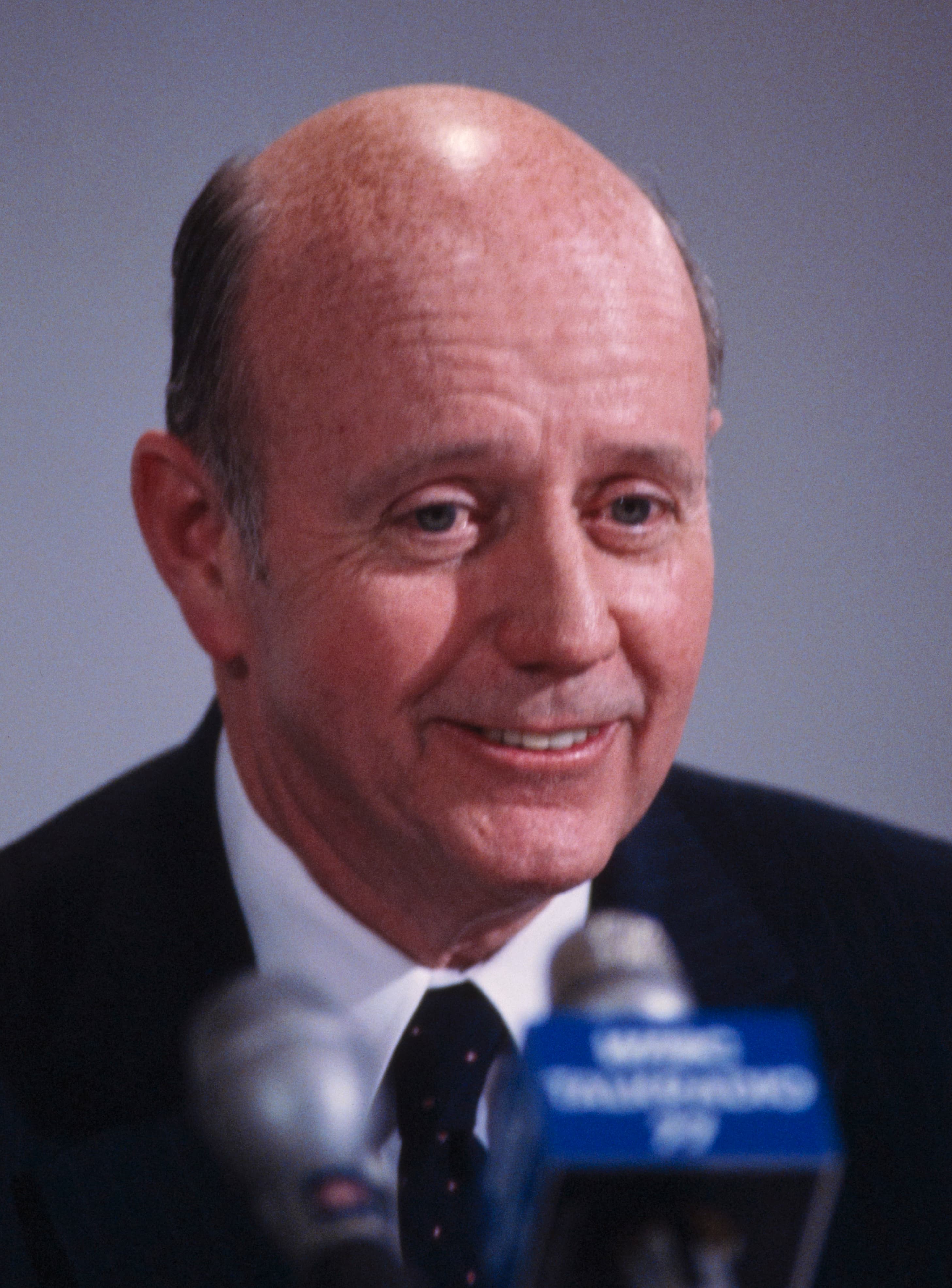
Tom Murphy
CEO, Capital Cities/ABC
One of Buffett's most admired business managers; close friend and board director of Berkshire.
Biography
Thomas S. Murphy (1925–2022) was a broadcasting executive who built Capital Cities Communications from a single struggling UHF television station in Albany, New York, into one of the most valuable media companies in America — and the man Buffett has called, without qualification, the best business manager he ever met.
Murphy was born in Brooklyn, served in the U.S. Navy, and took an engineering degree at Cornell before earning an MBA from Harvard Business School. In 1954 he left a brand-management job to run a bankrupt UHF station in Albany for broadcaster and author Lowell Thomas, who was assembling the small group that became Capital Cities. The station signed on in 1954 and turned profitable almost immediately, and the pattern was set: buy carefully, run lean, let good people do their jobs.
Capital Cities went public in 1957 and grew for three decades by buying undervalued television and radio stations, then newspapers and cable systems, always at prices that left room for error. In 1985 the company executed the boldest deal in broadcast history: the $3.5 billion acquisition of the American Broadcasting Companies, a network several times its own size. Buffett financed the deal, buying three million shares of Capital Cities at $172.50 per share. In 1995 Murphy and his longtime partner Dan Burke sold Capital Cities/ABC to Disney for $19 billion, and Murphy retired. He died in May 2022, at 96.
Key Stories
The Managerial "Twofer" — In the 1981 letter, Buffett sorted successful acquirers into two categories: companies that buy inflation-proof businesses, and managerial superstars who can find value anywhere. He named only a handful of executives in the superstar class, and put Murphy at the head of it — a leader of both categories at once.
The Phone Call That Financed ABC — When Capital Cities agreed to buy ABC in March 1985, Murphy called Buffett. As the 1984 letter's subsequent-event note records, Berkshire committed to purchase three million shares at $172.50 — about $517.5 million — contingent on the ABC transaction closing. The 1985 letter explained why the size of the check was easy: Buffett had been on record for years calling Cap Cities the best-managed publicly-owned company in the country.
The Station Buffett Didn't Buy — Around 1972, Murphy called Buffett to offer him the Dallas-Fort Worth NBC station for $35 million. Capital Cities had to divest it under cross-ownership rules, and Murphy told Buffett directly that the purchase was certain to work. Buffett passed, and later called it one of his great mistakes — a See's-like business that needed almost no capital and showered cash on its owners. The 2007 letter tells the story as a confession.
The Sun Valley Sidewalk — The 1995 letter records how the Disney merger actually began: at about 1:15 p.m. on July 14, 1995, Disney CEO Michael Eisner was walking up Wildflower Lane in Sun Valley just as Buffett was leaving a lunch to meet Murphy for a golf game. Buffett congratulated Eisner on a presentation he had given that morning, they chatted, and the subject of combining Disney and Cap Cities came up. The deal followed within weeks.
"Praise by Name, Criticize by Category" — Sixty years before the 2024 letter, Murphy gave Buffett a management rule that Berkshire still follows in its annual reports: when discussing problems at subsidiaries, praise individuals by name and criticize only by category. The 2019 letter records a second Murphy maxim on acquisitions: "To achieve a reputation as a good manager, just be sure you buy good businesses."
Impact on Berkshire
Murphy's influence on Berkshire runs deeper than any single investment, though the investments alone would justify it: the original $517.5 million Cap Cities position came back many times over through the Disney sale.
The Decentralization Template. Murphy ran Capital Cities with a tiny headquarters, no corporate staff layers, and near-total autonomy for the people running each station and newspaper — paired with strict accountability for results. That is the operating model Berkshire uses today. Buffett watched it work at Cap Cities for decades before describing it as his own.
The Cost-Discipline Standard. The 2004 letter records a lesson Murphy drove home with a hypothetical tale: an employee asking to hire a $20,000-a-year assistant should be evaluated as making a $3 million decision, once lifetime raises, benefits and other expenses are counted. Buffett cites it as the mindset a well-run company needs — attack costs as vigorously when profits are at record levels as when they are under pressure, a habit he explicitly credited to Murphy and Burke in the 1990 letter.
The Management Benchmark. For half a century Murphy has been the standard against which Buffett measures other managers — from Wells Fargo's Carl Reichardt and Paul Hazen in 1990 to Berkshire's own subsidiary CEOs. In the 2015 letter he went further: choose your exemplars carefully, start with Tom Murphy, and you will never need a second one. Alongside Charlie Munger, Murphy is one of the two people Buffett most often tells shareholders to copy.
Board Service. In 2003, when Berkshire rebuilt its board around business savvy and shareholder orientation, Buffett named four new directors, all friends whose strengths he knew well; Murphy was one of them. He remained a Berkshire director until 2022.
Key Passages from Buffett's Letters
We salute such managers as Ben Heineman at Northwest Industries, Henry Singleton at Teledyne, Erwin Zaban at National Service Industries, and especially Tom Murphy at Capital Cities Communications (a real managerial “twofer”, whose acquisition efforts have been properly focused in Category 1 and whose operating talents also make him a leader of Category 2).
And Tom Murphy and Dan Burke are not only great managers, they are precisely the sort of fellows that you would want your daughter to marry. It is a privilege to be associated with them - and also a lot of fun, as any of you who know them will understand.
In many ways the combination of Carl and Paul reminds me of another - Tom Murphy and Dan Burke at Capital Cities/ABC. First, each pair is stronger than the sum of its parts because each partner understands, trusts and admires the other. Second, both managerial teams pay able people well, but abhor having a bigger head count than is needed. Third, both attack costs as vigorously when profits are at record levels as when they are under pressure. Finally, both stick with what they understand and let their abilities, not their egos, determine what they attempt.
Thirty years ago Tom Murphy, then CEO of Cap Cities, drove this point home to me with a hypothetical tale about an employee who asked his boss for permission to hire an assistant. The employee assumed that adding $20,000 to the annual payroll would be inconsequential. But his boss told him the proposal should be evaluated as a $3 million decision, given that an additional person would probably cost at least that amount over his lifetime, factoring in raises, benefits and other expenses (more people, more toilet paper).
It has an insightful chapter on our director, Tom Murphy, overall the best business manager I’ve ever met.
These two were the best managerial duo -- both in what they accomplished and how they did it -- that Charlie and I ever witnessed. Much of what you become in life depends on whom you choose to admire and copy. Start with Tom Murphy, and you’ll never need a second exemplar.
Tom Murphy, a valued director of Berkshire and an all-time great among business managers, long ago gave me some important advice about acquisitions: "To achieve a reputation as a good manager, just be sure you buy good businesses."
When discussing problems at specific subsidiaries, we do, however, try to follow the advice Tom Murphy gave to me 60 years ago: "praise by name, criticize by category."